Modern ballplayers are ripped. They are stacked. They are cut.
However you choose to term it, baseball players lift a lot of weights and generally turn up for camp in February in good shape.
In other words, they are "yoked," according to David Wells, a guy who most definitely was not yoked during his career.
Wells' description came in a New York Times story about the Yankees' outsize rotation--large not just in salary, but in physical stature.
Reports the Times:
"They’re ginormous,” marveled the beefy Wells, now an instructor at Yankees camp. “I’ve never seen a rotation that big, and that includes me. I mean, I wasn’t yoked like most of these guys; I was just fat. But with that size, it can be intimidating.”
The story notes that players' listed weights can sometimes be off a bit. Wells himself, pitching in at Yankee camp these days, can confirm that.
Wells, who is still almost comically listed as 6-3, 187, said the most weight he ever carried to the mound was 278 pounds — almost none of it muscle.
Friday, March 9, 2012
Tuesday, March 6, 2012
Further Proof That A-Rod is 'Nuts'

There was a funny little exchange between A-Rod and the beat reporters Sunday in Tampa.
Alex had a dreamy start to spring training, taking none other than Doc Halladay deep on the first pitch he saw in 2012. (Last pitch he saw in 2011 was missed, thus ending the Yankees' season.)
A-Rod was asked Sunday if he believed in omens.
"In almonds?" he shot back, incredulously, as reported in the NY Times. He'd thought he'd heard everything from the press corps.
"Omens," he was told.
"Like Gregg Allmann, and Duane Allmann, and the month-long residency at the Beacon every March? Ramblin' Man and all that?" he said.
OK, A-Rod did not say the above. He said this:
"You mean like a foreshadowing?"
Yes, that is it.
On the day, the Phightin' Phils shelled starter Freddy Garcia, as it were, though the Yankees took the game 7-4.
Wednesday, January 11, 2012
'90 Reds Took it Down to the 'Wire'
The 1990 Reds became the last World Series winner from before the wild card era to get a guy into the Hall of Fame, but they got their guy yesterday when Barry Larkin earned a golden ticket to Cooperstown.
The team had some great, fiery personalities, from skipper Lou Piniella to the knucklehead bullpen trinity known as the Nasty Boys, in Rob Dibble, Randy Meyers and Norm Charlton.
Piniella gave the team its identity, says Larkin.
Reports the NY Times:
Larkin said that Piniella, a former Yankee, made some people nervous because he had not talked with many players before spring training in Plant City, Fla. In his first meeting with the team, Piniella surveyed the clubhouse and said, in salty language, that he hated to lose and would not accept it. Then he left the room.
“[Coach] Jackie Moore says, ‘O.K., boys, let’s go to work,’ ” Larkin said. “We went wire to wire that year.”
Wire to Wire means, of course, jumping out to first place from the get-go, and staying there for the remainder of the season. Not easy to do. It's also used in less dramatic fashion to describe a single game: taking the lead early on, and holding on for the win.
Wire to wire presumably takes its name from running races, and the metaphor is used in other sports too. Just last month, duffer Lee Greenwood went wire to wire in Thailand.
Reports the AP:
Lee Westwood completed a wire-to-wire victory in the Thailand Golf Championship, shooting a 3-under 69 in windy conditions Sunday to beat Masters champion Charl Schwartzel by seven strokes.
The third-ranked English star finished at 22-under 266 at Amata Spring Country Club.

The phrase is familiar enough, at least in baseball, to grace the cover of the book about, yes, the 1990 Reds.
It sounds as though baseball's newest Hall of Famer might even own a copy of it.
The team had some great, fiery personalities, from skipper Lou Piniella to the knucklehead bullpen trinity known as the Nasty Boys, in Rob Dibble, Randy Meyers and Norm Charlton.
Piniella gave the team its identity, says Larkin.
Reports the NY Times:
Larkin said that Piniella, a former Yankee, made some people nervous because he had not talked with many players before spring training in Plant City, Fla. In his first meeting with the team, Piniella surveyed the clubhouse and said, in salty language, that he hated to lose and would not accept it. Then he left the room.
“[Coach] Jackie Moore says, ‘O.K., boys, let’s go to work,’ ” Larkin said. “We went wire to wire that year.”
Wire to Wire means, of course, jumping out to first place from the get-go, and staying there for the remainder of the season. Not easy to do. It's also used in less dramatic fashion to describe a single game: taking the lead early on, and holding on for the win.
Wire to wire presumably takes its name from running races, and the metaphor is used in other sports too. Just last month, duffer Lee Greenwood went wire to wire in Thailand.
Reports the AP:
Lee Westwood completed a wire-to-wire victory in the Thailand Golf Championship, shooting a 3-under 69 in windy conditions Sunday to beat Masters champion Charl Schwartzel by seven strokes.
The third-ranked English star finished at 22-under 266 at Amata Spring Country Club.

The phrase is familiar enough, at least in baseball, to grace the cover of the book about, yes, the 1990 Reds.
It sounds as though baseball's newest Hall of Famer might even own a copy of it.
Tuesday, October 25, 2011
'Rally Beers' Come Up Flat
We've all heard of rally caps, and even Aubrey Huff's fearsome rally thong. But thanks to the boozing and losing 2011 Red Sox, now we have rally beers.
Jon Lester told the Boston Globe that he and other pitchers who were not scheduled to pitch would sometimes drink a "ninth-inning rally beer" in the clubhouse during games, reports CBS News.
The Sox are not the only team to partake in a rally beer.
Reports Sporting News:
Chicago White Sox catcher A.J. Pierzynski admits a "rally beer" sometimes is necessary.
"Yes, absolutely I have before," Pierzynski said on 'The Dan Patrick Show' when asked if he ever had a drink in the clubhouse. "Sometimes you're just really struggling and you just say, 'Hey, you know what, I need something to calm me down and let's have a beer.' A couple of us will do it together, and sometimes it works out.
"It's just, sometimes you just need a rally beer. If you're in extra innings and you're in about the 15th inning and you really need to get going again, that sometimes works for you."
Pierzynski says he and some teammates also did shots before a 2008 ALDS game against the Rays.
The Rays won that series, 3-1.
The Sox of course imploded amidst the rally beering in September.
Maybe we're better off leaving the potent potables to the fans in the stands.
Jon Lester told the Boston Globe that he and other pitchers who were not scheduled to pitch would sometimes drink a "ninth-inning rally beer" in the clubhouse during games, reports CBS News.
Funny how slugging Jack Daniel's was considered key to the Sox' unlikely comeback against the Yankees in 2004, but chugging beers doomed the 2011 lot.
Reports Sporting News:
Chicago White Sox catcher A.J. Pierzynski admits a "rally beer" sometimes is necessary.
"Yes, absolutely I have before," Pierzynski said on 'The Dan Patrick Show' when asked if he ever had a drink in the clubhouse. "Sometimes you're just really struggling and you just say, 'Hey, you know what, I need something to calm me down and let's have a beer.' A couple of us will do it together, and sometimes it works out.
"It's just, sometimes you just need a rally beer. If you're in extra innings and you're in about the 15th inning and you really need to get going again, that sometimes works for you."
Pierzynski says he and some teammates also did shots before a 2008 ALDS game against the Rays.
The Rays won that series, 3-1.
The Sox of course imploded amidst the rally beering in September.
Maybe we're better off leaving the potent potables to the fans in the stands.
Monday, October 24, 2011
Swift Pitcher Throws 'Asprin'-Fast
When a player is hitting well, the ball looks as large as watermelon, or perhaps a cantaloupe (pamplemousse, en francais).
When he's not, it's a seed or a pill.
Or an aspirin tablet, as noted in a recent Sports Illustrated.
There's a very entertaining feature in the October 17 issue on a career minor league pitcher with a golden arm. "The Invisible Fastball" is about Jack Swift, who turned heads at backwater baseball stops such as Savannah and Buffalo and Elkin, NC in the '40s and '50s, all the while befuddling hitters with a blazing fastball, and racking up astounding numbers of innings.
Write Chris Ballard and Owen Good of the fastball:
"Teammates say it hissed, as if searing the air. In the parlance of the day Jack threw an aspirin tablet--that's how small the ball appeared to the hitter."
The writers take a close look at Swift's performance in 1953, pitching in Marion, NC. Swift threw a stunning 287 innings in a 108 game season, striking out 321 and winning 30.
Swift pitched before the radar gun offered a precise number to show just how hard a pitcher threw, and so his legend grew.
It's a really fun read.
When he's not, it's a seed or a pill.
Or an aspirin tablet, as noted in a recent Sports Illustrated.
There's a very entertaining feature in the October 17 issue on a career minor league pitcher with a golden arm. "The Invisible Fastball" is about Jack Swift, who turned heads at backwater baseball stops such as Savannah and Buffalo and Elkin, NC in the '40s and '50s, all the while befuddling hitters with a blazing fastball, and racking up astounding numbers of innings.
Write Chris Ballard and Owen Good of the fastball:
"Teammates say it hissed, as if searing the air. In the parlance of the day Jack threw an aspirin tablet--that's how small the ball appeared to the hitter."
The writers take a close look at Swift's performance in 1953, pitching in Marion, NC. Swift threw a stunning 287 innings in a 108 game season, striking out 321 and winning 30.
Swift pitched before the radar gun offered a precise number to show just how hard a pitcher threw, and so his legend grew.
It's a really fun read.
Tuesday, October 18, 2011
Red Sox Lester 'Wears' Scarlet Letter Proudly
"Did we drink an occasional beer? Yes," Jon Lester told the Boston Globe Monday. While his Popeye's eating cohorts Josh Beckett and John "Oh-my-god-please-pay-this-mans-entire-salary-and-gift-him-to-a-low-market-team-imediately" Lackey still haven't uttered a word about the Sox epic September fail, Lester tried his best to take some responsibility for his actions.
"We ordered fried chicken maybe three times in six months. Other guys who were not playing that day would come in and have a bite to eat," Lester said. "But what people are trying to do is a witch hunt. They're looking for any reason to basically tear somebody's head off because we lost, and people right now are saying it's because we did this. I'm not shying away from saying I did it."
This, in baseball clubhouses, is what is known as "wearing it." Wearing it is what ballplayers do when they are forced to take responsibility for something they may or may not feel responsible for. It also implies falling on one's sword for the greater good of the team.
I spent this summer in the sweltering heat (like 47 straight days over 100 degrees, my head is melting off sweltering) of Shreveport, Louisiana calling games for Your 2010 American Association of Independent Baseball Champion Shreveport-Bossier Captains. The 2011 Captains, much like the 2011 Red Sox, were underachievers. Shreveport returned 17 players from their championship run, but they never really got it going.
The Captains worked through a lot of injuries (our 35-year-old pitching coach who hadn't pitched professionally in three years and weighed close to 250 pounds started a game) and a lot of questionable roster decisions (the first position player the Captains cut ended up being the only one to return to the Major Leagues this year...pinch runner extraordinaire Joey Gathright, who ended up watching the September debacle in Boston in a Red Sox uniform in the Fenway Park dugout) and ended up 10 games under .500 and out of the playoffs.
It was in the Captains clubhouse that I learned about wearing it. Our catcher was charged with an error on an attempted steal when his throw bounced off the glove of our shortstop, bounded into centerfield and allowed the baserunner to take third. After the game he was upset about the official scorer's decision. "I've been wearing calls like that all year," he said.
Our second baseman got his legs taken out from under him covering second on a double play grounder. "Shortstop should have gotten me the ball sooner," he said. "I just gotta wear it."
Our pitching coach (who walked six guys in two innings...it was a less-than-Ali-like comeback, was griping about his pitchers blaming pitch selection for their woes. "Pitch your game. If you don't like the call, shake him off. If not, make your pitch and wear it."
As you can tell, it was a season of wearing it over and over. We wore it all summer.
And I learned that ballplayers do not like wearing it. In fact, they hate wearing it. Baseball is such an insular environment where players are allowed, and sometimes encouraged, to act out teenage whims and desires (like drinking beers and playing video games when you know you're not supposed to) that when players are called out by the public, they are put in the uncomfortable and unfamiliar position of taking responsibility.
Instead of "owning it," which connotes taking full responsibility without passing the buck even passively (as Lester did when he said his former manager Terry Francona "didn't rule the clubhouse with an iron fist,") ballplayers often "wear it," which implies carrying around the burden of responsibility. Which is what most adults do when they make a mistake.
But hey, if Carl Crawford doesn't give that Robert Andamo base hit "the Union Pacific", the Sox might be in the playoffs and no one would be discussing who is going to be owning it and wearing it all the way through a very long winter.
--Guest post by David Tanklefsky
[image: CBS News]
"We ordered fried chicken maybe three times in six months. Other guys who were not playing that day would come in and have a bite to eat," Lester said. "But what people are trying to do is a witch hunt. They're looking for any reason to basically tear somebody's head off because we lost, and people right now are saying it's because we did this. I'm not shying away from saying I did it."
This, in baseball clubhouses, is what is known as "wearing it." Wearing it is what ballplayers do when they are forced to take responsibility for something they may or may not feel responsible for. It also implies falling on one's sword for the greater good of the team.
I spent this summer in the sweltering heat (like 47 straight days over 100 degrees, my head is melting off sweltering) of Shreveport, Louisiana calling games for Your 2010 American Association of Independent Baseball Champion Shreveport-Bossier Captains. The 2011 Captains, much like the 2011 Red Sox, were underachievers. Shreveport returned 17 players from their championship run, but they never really got it going.
The Captains worked through a lot of injuries (our 35-year-old pitching coach who hadn't pitched professionally in three years and weighed close to 250 pounds started a game) and a lot of questionable roster decisions (the first position player the Captains cut ended up being the only one to return to the Major Leagues this year...pinch runner extraordinaire Joey Gathright, who ended up watching the September debacle in Boston in a Red Sox uniform in the Fenway Park dugout) and ended up 10 games under .500 and out of the playoffs.
It was in the Captains clubhouse that I learned about wearing it. Our catcher was charged with an error on an attempted steal when his throw bounced off the glove of our shortstop, bounded into centerfield and allowed the baserunner to take third. After the game he was upset about the official scorer's decision. "I've been wearing calls like that all year," he said.
Our second baseman got his legs taken out from under him covering second on a double play grounder. "Shortstop should have gotten me the ball sooner," he said. "I just gotta wear it."
Our pitching coach (who walked six guys in two innings...it was a less-than-Ali-like comeback, was griping about his pitchers blaming pitch selection for their woes. "Pitch your game. If you don't like the call, shake him off. If not, make your pitch and wear it."
As you can tell, it was a season of wearing it over and over. We wore it all summer.
And I learned that ballplayers do not like wearing it. In fact, they hate wearing it. Baseball is such an insular environment where players are allowed, and sometimes encouraged, to act out teenage whims and desires (like drinking beers and playing video games when you know you're not supposed to) that when players are called out by the public, they are put in the uncomfortable and unfamiliar position of taking responsibility.
Instead of "owning it," which connotes taking full responsibility without passing the buck even passively (as Lester did when he said his former manager Terry Francona "didn't rule the clubhouse with an iron fist,") ballplayers often "wear it," which implies carrying around the burden of responsibility. Which is what most adults do when they make a mistake.
But hey, if Carl Crawford doesn't give that Robert Andamo base hit "the Union Pacific", the Sox might be in the playoffs and no one would be discussing who is going to be owning it and wearing it all the way through a very long winter.
--Guest post by David Tanklefsky
[image: CBS News]
Friday, October 7, 2011
Word of the Day: SCHADENROID
SCHADENROID /noun/ shadd en ROYD: Taking great pleasure from the failure of ballplayers linked to performance-enhancing substances.
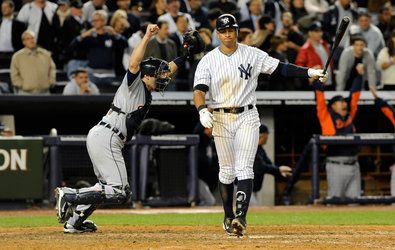
Usage: My schadenroid shot through the roof when I saw A-Rod whiff with the bases loaded in the 7th last night, and then strike out to end the game--and the Yankees' season.
[image: NY Times]
performance enhanced...not!
[image: NY Times]
Subscribe to:
Posts (Atom)