Monday, July 16, 2018

Baseball Squads Feature a Closer...and an 'Opener'

In baseball parlance, an "opener" was historically the season's first game, or maybe the first game in a series against another team. Ya know, I'm skipping work to hit the opener at the Stadium, or, Kershaw is pitching in the opener against the Giants.

These days, opener probably refers to the Tampa Bay Rays' intriguing experiment of going with a cadre of relief pitchers every fifth time through the rotation, with an "opener" starting the game and offering a couple innings, and giving the opposing hitters one less look at the guy picked to hurl most of the innings.

The first true opener, according to The Ringer, was Sergio Romo:
The new terminology itself indicates the novelty of Romo’s weekend role. He started two games after making his first 588 career appearances as a reliever. But he was doing so on consecutive days, with the express purpose of clearing the top of the Angels’ lineup before making way for pitchers—normally starters—who would give Tampa Bay more innings. Romo was technically starting, but not in the traditional sense of the term. He was opening—the games, and, perhaps, a futuristic path to ordering a pitching staff.

The blog Rays Colored Glasses applauded the Tampa Bay squad for upending baseball tradition, only to question, a week later, if it was "Closing Time on Openers." 

The first story--the complementary one--read:


Give Kevin Cash and the Rays organization credit for again trying something different.  There’s no doubt that the Rays must be different to compete.  They will never have the payroll as many other teams in baseball.  But, they seem to have taken an aggressive approach to numbers.  Statistics.  And, that cannot be overlooked.

The whole opener debate took off in a Reddit post May 22. Reddit defines the opener as:

The Opener is basically a relief pitcher used at the start of the game. Like many standard relievers, the Opener has a limited, but important role to play in how teams could win games.

Tuesday, April 10, 2018

Mets Manager Introduces New York to 'Dirtball Read'

During the Mets game last night, the broadcast shifted to a taped interview with manager Mickey Callaway, who addressed a question about the Mets' general lack of speed, and said that savvy and aggressive baserunning can make up for the mostly old, mostly slow runners on the Mets squad.
Callaway talked about a ball in the dirt, and how a smart baserunner can make a good "dirtball read" and bolt to the next base.

In fact, he said "dirtball read" twice.
And when the interview ended and things went back to the booth, Gary Cohen was delighted to share the new baseball term he'd picked up.
Yes, dirtball read. How well you pick up on a pitch in the dirt.
Ron Darling offered his own take on "dirtball read," saying how his parents would advise him to stay away from a "slovenly person" when he was a kid.
The guys sensed they were on to a cool, funky term. "It may be viral," they said. "It may be a t-shirt."
Googling "dirtball read," I see the term has been around for a bit. Here's Pittsburgh City Paper last month:

On March 19, Gerrit Cole had his best spring-training outing to date. The Pirates pitcher struck out five and gave up only one run, and the control on his fastball was pretty masterful. But when he met with reporters after the game, it was his other performance that started the conversation.
Cole went 1-2 at the plate with a two-run single, and almost a stolen base. He took second on a pitch in the dirt; the official scorer didn’t award him the steal, but he wasn’t discouraged.
“That’s all right. I’m not chasing stolen bags, I’m chasing stars,” Cole said referring to the “Stargell Stars” that coaches hand out for standout performances. He was looking for one from Kimera Bartee, the Bucs’ first-base and base-running coach. “And what we say in here is the fastest way to get a star is to get 90 feet. KB’s real generous with those stars, so I’m hoping I get my first one.”
Cole even impressed his manager, Clint Hurdle. “It’s called a dirtball read,” Hurdle said with a smile.

And here's the Boston Globe four years ago, when Mike Napoli dislocated his finger. 


“Good dirtball read like that, I was digging myself, and then I looked at my finger and it’s freakin’ sideways so it’s good news it’s not broken,” Napoli said. “I know I hit the bag pretty hard and I looked and it was right there in front of my face, then I saw it and I went, ‘oh, God’ [umpire] Jim Joyce was going ‘oh my God,’ calling for the trainer. It’ll be all right.”


Friday, August 4, 2017

Dellin Betances Is Immaculate

Football may have the Immaculate Reception, as the fabled Terry Bradshaw-to-Franco Harris pass from 1972 is known. But baseball has the Immaculate Inning, which sees a pitcher strike out the side on nine pitches.
Dellin Betances did it for the Yankees this week, throwing nine by the Detroit Tigers to earn his place in the record books. It was a rare highlight for Yankee fans on a rainy day.
Said the NY Times, "Those who stuck it out to the bitter end — there weren’t many — were rewarded with Dellin Betances’s best work of the season, a so-called Immaculate Inning in which he struck out the side – Jim Adduci, Justin Upton and Miguel Cabrera — on nine pitches in the eighth."
MLB.com and Deadspin were among the media outlets also using the phrase this week to describe Betances' rare accomplishment. 
Betances became the sixth Yankee pitcher to attain Immaculate status, said the Times, after Al Downing, Ron Guidry, A.J. Burnett, Ivan Nova and Brandon McCarthy.
Wikipedia has a dedicated section on the Immaculate Inning, and those who have thrown them. (The entry's title is a not very flashy "List of Major League Baseball pitchers who have struck out three batters on nine pitches."
Wikipedia says 82 pitchers have done it, and that includes Lefty Grove, Nolan Ryan and Randy Johnson doing so twice, and Sandy Koufax three times.
The first hurler to do it was Boston Beaneater John Clarkson, who did so against the Philadelphia Quakers back in 1889.

Monday, October 31, 2016

Andrew Miller Holds Cubs Hitters' Feet to the Fire

The 2016 World Series is a throwback, not just because it's Indians versus Cubs, but because of the way a fireman has been used to snuff out trouble. Indians skipper Terry Francona has been deploying almost unhittable reliever Andrew Miller as his fireman--the guy you call on to stamp out trouble with his mighty rubber galoshes, whenever that trouble surfaces. Sixth inning? Sure. Fourth inning? Could be.

It's a job that was much more common before the save became a major stat, and a high number of saves meant big bucks in salary.

As CBSSports.com noted near the beginning of the season, the sabermetrics geeks have been pushing the fireman model for some time. Writes R.J. Anderson:

For years, devout sabermetricians have urged teams to eschew the traditional closer approach and return to the fireman model -- that is, a roving reliever who checks in during the game's most crucial moment (as opposed to only the ninth inning), and who is able to throw multiple innings per outing. Maybe it's too early to declare Erasmo Ramirez the game's present-day fireman, but he's the closest thing going.

Joe Posnanski delves deep into the return of the fireman on NBC Sports, noting how John Hiller may have been the first of his kind back with the Tigers in the mid '60s. Posnanski gives then-Tigers manager Billy Martin the credit for using his ace reliever in what later became to be known as high leverage situations.

In many ways, Hiller was the first “Fireman,” a term that gained much more popular usage in the 1970’s. He was called to put out fires. And over the next decade or so, the fireman reined. Goose Gossage in 1975 was an extraordinary fireman. Bruce Sutter threw 107 innings in 1977 and had a 6.5 WAR, which would have led the National League this year.
Jim Kern in 1979 for Texas … Doug Corbett for Minnesota in 1980 … Willie Hernandez in his 1984 MVP season … these were firemen. In 1983, Dan Quisenberry set the record with 26 saves pitching at least two innings. The next year, he had 27, which remains the record. Bill Campbell in 1977 had 11 THREE inning saves. Gene Garber (remember him?) had 13 career FOUR inning saves. Rollie Fingers got to the Hall of Fame as a fireman; he had 131 career multi-inning saves, which is the most all time. Lee Smith was a fireman early in his career (though he morphed later into a more modern closer) Kent Tekulve was a fireman. Sparky Lyle … Jeff Reardon … Gary Lavelle … Roger McDowell, among others.

In fact, adept relievers were saluted as firemen years before Hiller took the hill. The Sporting News used to honor the "Fireman of the Year", with the best reliever in each league given the trophy. The award began in 1960 and was renamed Reliever of the Year in 2001. 

Cleveland's Plain Dealer opines that the fireman name, like so much from the '60s and '70s, deserves an update. How about, posits Doug Lesmerises, the Super Reliever?


Francona acknowledges that it's much easier to have a fireman do his thing in the post-season, when everything is at stake and there are several months to rest starting in a few days, than in the regular season. "I guarantee you everyone would like to have Andrew Miller. There's only one," Francona told the Plain Dealer. "There's not many. This isn't really rocket science what we're doing, and we're not reinventing the wheel either."
  

Tuesday, July 26, 2016

A Horse, a Stud, The Man, The *Guy*

Decent player. Not a 'guy.'
The team with the most "guys" will almost certainly contend for the World Series trophy come fall.
While every team has 25 guys on its roster--and more guys when rosters expand in September--no team truly has 25 "guys."
Why the quotation marks on "guys," you ask?
Because there are guys. And then there are guys.
According to the Twins' interim GM, Rob Antony, several of his players need to step up to guy level.
Goes the NY Times:
These Twins still believe they have elite young talent, including third baseman Miguel Sano, center fielder Byron Buxton and starter Jose Berrios. But all have disappointed this season.
“I think they want to be guys; I don’t think they know how to just yet,” Antony said, using baseball shorthand for impact players. “Sometimes you’ll see them and they kind of try and put on the facade or act like they’re guys. They’re not guys yet. So it’s going to take some time for them to mature and become major leaguers and be able to perform on a consistent basis. But we do believe that they’re going to be part of our core as we put this thing back together.”
Being a guy, or even the guy, looks like an offshoot of being the man. 
In Players Tribune last month, Mark DeRosa and Sean Casey, both former players and current MLB Network analysts, played around with the newish lingo. 
Casey said of Nomar Mazara:
He’s legit. I covered the Rangers during spring training and I remember talking with Guillermo Mercedes, who I played with in the minors, and we were on a side field and Mazara was hitting and Guillermo says, “Case, you see this guy right here? This is the guy! This guy is a stud!” He pulled him out of the cage and introduced me to him — really nice kid. A little bit later, I’m talking to Joey Gallo, another top prospect, and he points to Mazara and says the same thing, “This guy’s a stud.” And I’m like, “Wait, but everybody’s talking about you.” And Joey shakes his head. “No, man. This guy. He’s the guy.”
Added DeRosa:
Guys know when a guy is the guy.
Well said, guy. 


Thursday, June 23, 2016

Game 7, 1986: Darling Meets Doubleday, Mets Score a Willie

Mets TV analyst Ron Darling has a new book out, looking back on his career, and one game in particular. Game 7, 1986 is a detailed account of his substandard pitching performance in the final game of the '86 Series--following standout showings in Game 1 and Game 4.
The Mets, of course, went on to win the Series, but Darling's shoddy Game 7 stuck in his craw for years and years.
Darling dishes a bit about that colorful Mets squad, and some of the baseball language of the time.
A pitcher getting a win--a W, in common parlance--was also known as getting a Willie.
Conversely, a pitcher getting the loss picked up a Larry.
And what of the dreaded No Decision? At least in Metsland, it was a Nelson Doubleday. (See, ND!), after the publishing magnate who bought the Mets before Darling's time with the club--and the grandnephew of Abner Doubleday.
While it's no Ball Four, Darling does talk a bit about the chemical enhancers that helped players get from Game 1 to Game 162. The failure to launch was the name given to pills that did not do their job.
"You'd lay in just the right cocktail of pills, and time it just right, and still the body would fail to respond," writes Darling. "You'd see guys walking around the clubhouse with this panicked look in their eyes, because they'd done everything they could to get up and ready for the game, never counting on the fact that the physiology of the human body can change from day to day."
Meanwhile, the pre-launch was when the body peaked too early before a game, the pills doing their thing during BP, or in the clubhouse, way before first pitch.
I had a chance to interview Ron about the book, and found him astute and entertaining. He said he had three options for dealing with his frustrations from the fall of 1986--see a therapist, write a book, or indulge heavily in scotch.
I'm glad he chose option 2, as is his liver.

Thursday, June 25, 2015

Sanchez, With a Twist of Tiant

Aaron Sanchez was doing his thing against the Yankees the other night, hurling pitches on behalf of the Toronto Blue Jays. The Yanks appeared somewhat befuddled by his delivery.
"Sanchez does that Tiant Turn," said announcer Michael Kay. "It's a little disconcerting."
He was, of course, referring to Luis Tiant, who would spin toward second base before dealing a pitch. The Cuban Tiant won 229 games, many of them for the Red Sox, in the '60s, '70s and even into the '80s, generating extra power with his distinctive twist.
A discussion on Baseball Prospectus regarding Tiant mentions the "Tiant Twist". Said Doug Thorburn:
I wish that I could say that I had seen every manipulation of the Tiant twist, but I have only seen a handful of clips. But I dig it.
Perhaps Johnny Cueto of Cincinnati is the best known practitioner of the Tiant Twist. Here's what the Red Legs Baseball blog said on Opening Day last year:
Johnny Cueto looked great, but still uses the Tiant-twist. He'd better be right that the twist isn't causing his injuries, because we can't afford another oblique strain.
Tiant Twist seems more popular a term than Tiant Turn, but I do see a cocktail out there in the webiverse called the Tiant Turn. It's made of Brugal Anejo, Sherry, Mezcal and Orange Bitters, and garnished with an orange twist. 
I shall now raise a glass of Tiant Turn, and perhaps one of Tiant's trademark El Tiante cigars, to that colorful old pitcher. 

Tuesday, June 2, 2015

BATTER CHATTER BOOK REVIEW: "Abused by the New York Yankees", by Paul Priore and Gary Toushek


I was approached by the co-author of Abused by the New York Yankees, Gary Toushek, a few months ago, the writer wondering if Batter Chatter might be interested in writing something about the book. In fact, I was interested. Authored by Paul Priore, former Yankees assistant clubhouse attendant, the book takes on one of the most imposing sports franchises in the world with some scorching allegations. Abused also takes on the most beloved player in franchise history, and tars him with a salacious sex scandal.
I didn’t know what to think.
And so I read.
Abused is not a good book.  First off, it’s self-published—not a surprise, given the subject matter, and not a bad thing; I’ve self published myself and tend to not discriminate against the DIY set. But it looks off-brand, more like a bound galley than a book, and reads as if it is in desperate need of an editor, in just about every paragraph. It reinforces the cynicism some readers have about self-published works.
A gay man, Priore has a giant bone to pick with the Yankees. He alleges that a prominent pitcher sodomized him with a baseball bat while several teammates cheered. He mentions walking into the clubhouse sauna and finding two of the Core Four—Derek Jeter and Jorge Posada—locked in a tangle of, shall we say, passion. (The phrase “erect paddywackers” actually sees the light of day in this passage.) He alleges a whole lot of things. Then he alleges more.
If he had spelled out a handful of incidents in which he was aggrieved, the book would’ve been much stronger. Instead, Priore blasts every darn player, manager and front office exec he ever came in contact with, which turns the book into a long-ass, scattershot screed. George Steinbrenner is “Ol’ Turkeyneck.” He suspects that two marginal players in the Nineties, both married men, share amorous affection for each other, and sees homosexual tendencies all over the game—from catchers flicking crotch-level signs to pitchers, to players joking about penis size in the shower. It becomes clear very early on in the book that he has an axe to grind with any and all aspects of the Yankee universe.
He constantly names names—players he says committed actual crimes in the clubhouse, and also others who simply acted like knucklehead ballplayers, with no idea that, two decades later, the assistant clubhouse attendant would out them for loutish behavior in a book.
In case you didn’t get your fill of dry writing across the first 500 pages, Abused concludes with a report from the man who administered a polygraph test to Priore. Included to establish Priore’s credibility, the report had the opposite effect on me—the author trying too hard to show us his far-fetched claims are legit.
Full disclosure, I root against the Yankees and, am sheepish to admit, take delight in their misfortunes. (Their best hitter is A-Rod! Hah!) But I derived no pleasure in Abused by the New York Yankees, and, in fact, found it grossly unfair.


Thursday, May 21, 2015

How to Make a Maddux

Master craftsman Greg Maddux retired seven years ago, but his legend lives on with a prestigious accomplishment that bears his name. Throwing a "Maddux" involves a complete game shutout, and a pitch total in the double figures.

The blogger Jason Lukehart coined the term. On his "Ground Ball With Eyes" blog, he writes:
In 1998, I came across a box score for a game in which Maddux had thrown a complete game shutout, and used fewer than 100 pitches. I LOVED it! Ever since then, I've kept my eye out for such games and calling such a pitching line a "Maddux."

Maddux, known as The Professor for his studious approach to pitching, rang up 13 Madduxes in his glorious career, notes Lukehart, who is also managing editor at LetsGoTribe.com. 

In this era of three-hour games, Madduxes are the stuff of games that last two hours or less.

Here's the all-time Maddux leaderboard, led by a mile by, of course, Hall of Famer Greg Maddux.

1. Greg Maddux       13
2. Zane Smith            7
3. Bob Tewksbury     6
t4. Tom Glavine         5
t4. Roy Halladay        5

Lukehart's term has caught on, making him the envy of, oh, every baseball blogger out there. BeyondtheBoxscore.com writes about Henderson Alvarez of the Marlins climbing up the Maddux chart.

The New York Times noted May 9:
Shelby Miller of the Atlanta Braves became the first pitcher with a Maddux this season, using 99 pitches to beat Philadelphia last week. It was the 290th Maddux since 1988.

The phenomenon even has its own hashtag. Tweeted Athletics Nation scribe Jeremy F. Koo (‏@jfkooAN) tweeted earlier this month,  "Jesse Chavez, exactly 77 pitches through 7 innings, no runs allowed. #MadduxAlert." (Alas, Chavez got but one more out that eve, though he did get the win.)

After typing "Maddux" several times in the last few minutes, I'm thinking "Mad Ducks" would make for a cool minor league franchise. That too would be a great way to commemorate the exceptional hurler.

Lukehart tells Batter Chatter (yes, we do a bit of original reporting every now and then) that seeing the "Maddux" catch on in the baseball lexicon has been a "great thrill."
"A lot of credit goes to [NBCSports.com baseball writer] Craig Calcaterra, who was the first person to mention it at a larger outlet than my little blog, and to [Grantland writer] Jonah Keri, who is a big fan, and has been gracious enough to mentioned it multiple times both in print and during Baseball Tonight. I owe Jonah a lot of drinks," says Lukehart. 
"Seeing MLB itself mention the Maddux has been awesome," he adds. "Now I just hope they mention me along with it one of these days. The ultimate though, that would be hearing Greg Maddux himself mention it. Fingers crossed."

Thursday, April 16, 2015

All A's On Ramirez's Report Card

A player whose skills go beyond the norm of a minor league player, yet fall a bit short of a major league athlete, is described as "4A"--a cut above a player competing in AAA baseball. SB Nation actually refers to these players as "Quad-A" and cites Wily Mo Pena and Brandon Moss among the patron saints of the Quad-A universe.
And then there's the "5A" player, which is how Red Sox first beardsman Mike Napoli describes new mate Hanley Ramirez.
Napoli told the NY Times:
“Hanley’s one of the best hitters I’ve seen. I always tell him he’s 5A — he’s above the big leagues. His swing, the way he backspins balls, it’s just different than how other people hit."
I have reason to believe Napoli has invented this term. Noodling around on the old Google, I see "5A" is a division of Texas schoolboy baseball. I see many mentions of five-tool players--guys who, as any fan of the game will tell you, can hit for average (1) and for power (2), throw (3), run (4) and field (5). I don't see any mention of 5A players.
I lived in apartment 5A in Manhattan's East Village for a dozen years; my email today, a decade since I moved out, has '5A' in it for that reason. To be a 5A player when referencing my old apartment would be to drink and smoke too much, to subsist primary on bacon-egg-and-cheese sandwiches from Cooper Diner, and to have surprisingly fit calves due to the sixth-floor walkup nature of our cramped digs.
But Ramirez, signed for $88 million over four years, is not living in a century-old tenement alongside a gaggle of elderly Ukrainian ladies and a few foreign-born NYU students, and hopefully is mixing in some salads with his bacon-egg-and-cheeses.
Napoli says his 5A teammate is one of a kind:
"Some people just got it. And he’s got it.”

Thursday, March 12, 2015

Sorry to Quibble, But He's Called a 'Gribble'

We have starters.
We have relievers of all stripes--closers, set-up men, mop-up men.
But what about the guys who both start and relieve?
They are, or at least should be, called "gribbles," posits Russell Carleton of the "Just a Bit Outside" blog on FoxSports.com.
If you're wondering about gribble's etymology, I don't believe it has any. It's just a fun word. It's also "any of about 56 species of marine isopod from the family Limnoriidae. (pictured right) They are mostly pale white and small crustaceans," says Wikipedia. Urban Dictionary, meanwhile, says that "gribble," in Hawaii, means falling, or "eating it." 
So maybe there's a touch of etymology there--the sometimes starter/sometimes reliever simply eats innings.
Carleton, in a detailed essay making the case for six-man rotations, notes that those starters-relievers are at times called a "swingman." That's really a euphemism, he says, for:
...€œthe guy who made the team as a minor-league invite and who we mostly send out there as a sacrificial lamb when we'€™ve run out of other warm bodies and who will probably be sent to AAA at the next convenient opportunity."€
I wonder if teams would do this if they could say to a pitcher, "€œWe want you to be a gribble for us,"€ and everyone knew what that meant.

The gribble could revolutionize baseball, says Carleton:
A team that embraced this six-man rotation model and who could convince three guys to take on this new/old gribble/swingman role could probably find guys whom the league only valued as back-end starters and turn a bit of straw into gold as a result.

Friday, February 20, 2015

The Higher the Slash Line, the Bigger the Contract

Kordell Stewart was known as Slash in his Pittsburgh Steelers days, for his ability to play quarterback, slash wide receiver, slash maybe another position, I don't know, it was 15 years ago.

Saul Hudson was dubbed "Slash" but his best friend's dad growing up in England; he later became the guitarist for Guns 'N Roses.

More recently, a ballplayer's true measure of offensive value is his slash line. Says Baseball Reference, it's a "short listing of a player's key offensive statistics. In the 1990s, it replaced the former Triple Crown stat usage, as it more aptly describes a player's offensive contributions."

Slash line is batting average, slash, on base percentage, slash, slugging percentage.

So entrenched in the baseball lexicon--why didn't we write about this sooner?--is the slash line that it's even got its own verb form.

Reports Fan Graphs back in 2011:

In 120 plate appearances, [Bobby] Abreu is slashing .271/.417/.375. The season is still young, but out-OBPing a slugging percentage after 80-100 PAs is strange to the eye. 

I bet it would go up further if Abreu was wielding Slash's Gibson Les Paul. 


[ADVERTISEMENT] Fantasy: In Troy We Trust


Derek Jeter is now officially retired, and that means a new era of shortstop is officially upon us. The Yankee captain was not a top five shortstop in the game his last few seasons, but here is a look at the best guys to keep an eye on in fantasy baseball.

Troy Tulowitzki

The Colorado Rockies look awful on paper going into the 2015 season, but they do have the best overall shortstop in the game when healthy. No one knows for sure if they will keep him on the roster or trade him away to try and rebuild the franchise. His ability to be a great all-around hitter and also play above average defense makes him highly sought after.

Ian Desmond

With so many stars on the Washington Nationals, Desmond seems to be overlooked by a lot of fans. He is a very solid all-around player for Washington, and he is a big reason why their World Series favorites. He is in the prime of his career, and he has been mostly durable which factors into fantasy baseball value as well.

Hanley Ramirez

Many people don’t care for the defense Ramirez brings to the table, but he is still a very solid hitter. He should be even better now that he is playing for the Boston Red Sox in a pretty nice ballpark. His homeruns should go up a little bit, and he has a chance to improve in other aspects as well. He is starting to get up there in age a little bit, but he still has at least a couple of years left to play at a high level.

Starlin Castro

A very solid 2014 campaign has Castro feeling very well about the future. This is a shortstop looked at by the Chicago Cubs as a face of the franchise. He is just 25 years of age, but it seems like he has been playing at the MLB level forever. He might just be entering his prime finally, and this has people intrigued.


[ADVERTISEMENT]

--Matt Stevens 

Tuesday, August 26, 2014

Of Monsters and 'Monster Men'

The shift.

The second baseman moving over to short right, shortstop to right center, third baseman enjoying a smoke and a hot dog in the first row of the stands.

It's the baseball story of the 2014--that and all the glowing re2pect for the Yankee captain.

But what do you call that infielder hanging out in short right like an underage kid in a bar?

He's a monster man, saves David Cone.

"It looks like slow pitch softball out there," said Cone in a recent YES Network telecast. "The 'monster man' in those games played short right."

Boothmate Ken Singleton had his own term for the short, temporary right fielder.

"Monster man or rover," said Ken.

Maybe not enough people write about softball these days, but I don't see any use of "monster man" in a softball context in the interwebs.

I do see a football one on UTSports.com:
 
Three-time Vols football letterman Nick Showalter passed away on Monday at the age of 65. Showalter played "monster man" for the Vols from 1966-68. He went on to become a successful dentist in Knoxville.

And then:

In those days, Tennessee coach Doug Dickey often recruited prep quarterbacks, reasoning they were the best athletes on the team, and turned them into capable offensive and defensive players.
Dr. Showalter was one of those type players, playing defensive end and "monster man" during his career, a time in which the Vols won the SEC and national title in 1967 and graced three bowl games.
Apparently, "monster man" is a widely understood term down in Tennessee, as UT Sports offers no explanation as to what the heck it is.

But Wikipedia's "Glossary of American Football" defines it as:

A strong safety in a four-deep secondary with the ability to cover deep zones, defend against runs and, on occasion, play on the line of scrimmage.

The rover, says Answers.com, can be just about anywhere, as the word indicates.

The rover usually plays in shallow center-field, but like every other player (except the pitcher and catcher), can play anywhere on the field at any time.

Wednesday, July 16, 2014

Jeter Feeling 'Groovy' After Wainright Pipe Shot

Hey Adam Wainwright:

Maybe the next time you start the all-star game, don't through a cookie to the first batter you face!

And maybe, in case you do, in fact, serve up a giant meatball to the leadoff hitter, don't tell the media that you did so afterwards. It's insulting to the hitter...even if it's Derek Jeter...especially if it's Derek Jeter. It's insulting to the fans. It's insulting to the game.

And if you do choose to admit it to the media, don't later retract that statement by saying it was all a joke.

Lame!

In baseball parlance, Wainwright "grooved" the pitch to Jeter--gave him every chance to hit a straight fastball, which wasn't super-fast, in the Captain's final all-star game.

Wainright offered another term for it.

“I was going to give him a couple of pipe shots,” Wainwright told the NY Times. “He deserved it. I didn’t know he was going to hit a double or else I would have changed my mind. I thought he was going to hit something hard to the right side for a single or an out. I probably should have pitched him a little bit better.”

The Cardinals pitcher trotted out the verb form of "pipe shot" as well.

“I was hoping it would be the first pitch and he would take it,” he said. “Then I would say, ‘All right, I piped him one and he didn’t swing,’ so I could go to it. But I spiked it in the dirt. I gave him one more shot, and unfortunately he didn’t miss it.”

After a social media maelstrom broke out, Wainwright did what you do when your words spark a shitstorm. You say you were joking.

“Usually I kind of like to think about things before I say them, and obviously I didn’t do that very well,” he said. “And I’m an idiot. I made a mistake.”

Jeter doubled on the groove-y pitch. “If he grooved it, thank you," Jeet said. “You’ve still gotta hit it. But if that’s what he did, I appreciate it.”

There's some history of pitchers grooving pitches to notable hitters as a show of respect. The New York Post mentions Cal Ripken and Barry Bonds getting served up pipe shots late in their careers.

In '68, Denny McClain put one on a platter for Mickey Mantle when an aging Mantle was stuck on 534 homers--and tied for third on the all time list.

Asked how he wanted the pitch, the New York Times reports, Mantle said, “High and tight, mediocre cheese.”

Mediocre cheese is, of course, a synonym for a cookie or a meatball.

Now I must eat. 


Thursday, June 12, 2014

Strike One...Two...Three...Nine

Master-ful!

You can pitch a perfect game, as 23 men have in MLB history, but it doesn't mean you've pitched an immaculate inning.

Immaculate innings are when a pitcher throws nine strikes--no balls, no fouls. Just strike one, two and three--three times in a half inning. In fact, you're more perfect when you're immaculate than when you're perfect; perfect games, after all, feature lots of balls and fouls.

Garrett Richards of the L.A. Angels did it earlier this month, just two days after Justin Masterson was similarly immaculate for the Cleveland Indians. (Making things even more immaculate, Masterson did it against his old Boston Red Sox mates; the Sawx had traded Masterson and others for Victor Martinez in 2009. V-Mart split two years later as a free agent.)

Two others have had immaculate innings this season, says the NY Times: Cole Hamels of the Phightin' Phils and Brad Boxberger of the Rays.

The Double I has its own entry on Wikipedia, which says John Clarkson was the first player to get one when his mighty Boston Beaneaters (real team name) faced the Philadelphia Quakers (like the Phils, without the fighting), in 1889.

It's been done just 75 times in Major League history, reports Baseball Almanac.

The last Met to do it, if you're scoring at home, was David Cone in 1991.

Thursday, May 15, 2014

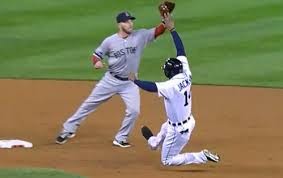
There Goes the Neighborhood Play

We've all seen it before.

Team A is looking to pull off a double play.

Team B is looking to disrupt said double play.

Team A's shortstop takes the toss from the second basemen, places his foot kind of/sort of near second base, and whips to first.

Out X 2.

This is, of course, the neighborhood play, which means the player does not actually have to step on second, but only has to be in the neighborhood of the base.

This allows middle infielders, as the New York Times put it in early May, "to protect themselves by getting out of the way of hard-charging runners."

The neighborhood play was initially feared to be going the way of letter-high strikes, posited Rob Neyer before the season started, thanks to the advent of video review. But it's not reviewable. 

Back in 2009, Rich Garcia, Major League Baseball umpire supervisor, denied there was such a thing. 
“There is no such thing as the neighborhood play,” he said. You either touch the base or you don’t.”

The New York Times says it's allowed, like pitchers and a spot of pine tar, as long as it's not too obvious. Stephen Drew was a little too obvious for the Red Sox during the American League Championship Series, though he did end up getting the out call.

“He wasn’t even in the neighborhood; he was in a different county," former middle infielder Alex Cora told the Times.


Neighborhood play is not to be confused with a neighborhood play, such as when Spanky, Alfalfa, Darla and the gang would get together to stage a little song and dance.

Tuesday, November 26, 2013

'14 Mets Have a 'Hoss' in the Race

With Matt Harvey having his elbow redone for the foreseeable future, the Metsies will need a serious horse to take the mound every fifth turn in 2014.

Better yet, maybe a hoss can lead the team from the hill.

A horse is, of course, a sturdy pitcher--a guy who eats up innings, ends losing streaks, and carries the team on his back, much like a, ya know, horse does.

That may be future Mets pitcher Noah Syndergaard.

"Noah's a hoss," said Brandon Nimmo, future Mets outfielder, in the NY Times after the Futures Game at Citi Field in July.

A hoss is southern slang for horse. It is not known at presstime if hoss is a higher compliment than horse.

Urban Dictionary describes "hoss" thusly:

One who is a beast that can basically do anything he wants. He is usually loved by all and a ladies man. He could break anyone or anything in half.

Perhaps unnecessarily, Urban Dictionary adds, "Hoss is a compliment."

Nimmo knows about horses. He's from Cheyenne, Wyoming. They have a lot of horses out there. They may even call them "hosses."

[ADVERTISING] Fantasy Baseball Puts A Stress On Numbers


More than any other major sport in the United States, baseball has always been about numbers. At its core, it is a team sport composed of a bunch of one-on-one battles, which makes it easy to compare and contrast players. In recent years, fantasy baseball has put even more of a stress on numbers. As owners draft their players and try to compose the best roster possible, fans are researching and studying more than ever.
Many fantasy baseball owners, especially the most competitive ones, are always looking for an edge. Some feel as though they now have one thanks to the rise in popularity of more complex statistics. Most fantasy baseball leagues still have basic categories such as batting average, home runs, strikeouts and more, but advanced statistics do a good job of helping a person predict output prior to the start of the season.
Statistics such as on-base percentage, batting average balls in play, isolated power and more are just the start for those who love to crunch numbers while also loving fantasy baseball and sports in general. Some are resistant to all of these numbers, and they certainly are not perfect, but it is a way for people to stay connected with the sport while sitting at their desk or on their computer.
The majority of baseball fans still get drawn in by those sexy numbers, such as Joe Dimaggio’s 56-game winning streak, hitting .400, hitting over 60 home runs and more. The issue is that the majority of the most well-known numbers are counting statistics. In a one year season, people are looking for consistency and efficiency with the players they draft on their fantasy baseball team.
Numbers are only going to become more and more prevalent for baseball fans, so those resistant to change should get used to it. Baseball is still known as a game that has to be played on a field, but analytical tools are always being created and tinkered with to try and explain what happened in the past, and what might happen in the future.


[ADVERTISING]

Tuesday, October 8, 2013

Darling's Trading In His Chevy For a Cadillac-ac-ac-ac-ac

If baseball announcers are to be believed, Cadillacs are best enjoyed at a modest cruising speed.
After all, "Cadillacing" after a batted ball means taking your time in getting to it.

"A simple ground ball up the middle in almost game, Heyward kind of Cadillacs in and gets that ball," said Ron Darling during Dodgers-Braves last week. "But he cannot with Puig running."

Darling has long had a thing for Cadillacs. As a minor leaguer back in 1982, he said in Newsday about making the Big Show:

"The money is secondary, really. I'm a pretty frugal guy, although in New York my frugalities might include a Cadillac."

During day games at CitiField, Darling will often share the booth with Ralph Kiner, who had a little something to say about Cadillacs during his illustrious playing career.

"Home run hitters drive Cadillacs," Kiner famously said, "and singles hitters drive Fords."

Funny, I was half tuning in last night to Sox-Rays, and another announcer on TBS--not Darling--referred to a player "Cadillacing" in for a fly ball. 

Did he get it from Ron? Or is it a real baseball term?

In fact, "Cadillacing" been around for some time. The radio program A Way With Words cites the Seattle Times waaayyy back in 1989:

"He moved to his right to catch a fly out, but Greg Gagne surprisingly tagged from first base and reached second when Griffey’s threw was too soft and wide. “I don’t like him ‘Cadillacing’ like that,” he said. 

The University of Oregon has the word in its online slang dictionary, and defines "Cadillacing" thusly:

To run in an unhurried, showy way; generally, to perform or operate lackadaisically, carelessly, or without worry  

Finally, we turn to hip-hop for a bit of clarity. The emcee Paul Wall rapped this in 2008:

These boys lazy Cadillac'ing, while I'm greenback stacking

So Cadillacing has been around for some time, yet seems to be the darling of the baseball announcer set these days.